Session XP: 0
C2 · 4.1.2–4.1.3Paper 1✅ Year 10 — already covered

Periodic Table

Groups, periods, electron configuration and trends. Group 1 alkali metals and Group 7 halogens. The basis for all bonding topics.

Best score
Last attempt
Best attempt progress
0
XP earned
Watch first
MyGCSEScience · AQA Chemistry
Periodic Table — watch on MyGCSEScience
FreeScienceLessons · AQA ChemistryThe Periodic Table — groups and periods
Cognito · AQA ChemistryPeriodic Table trends
Key facts

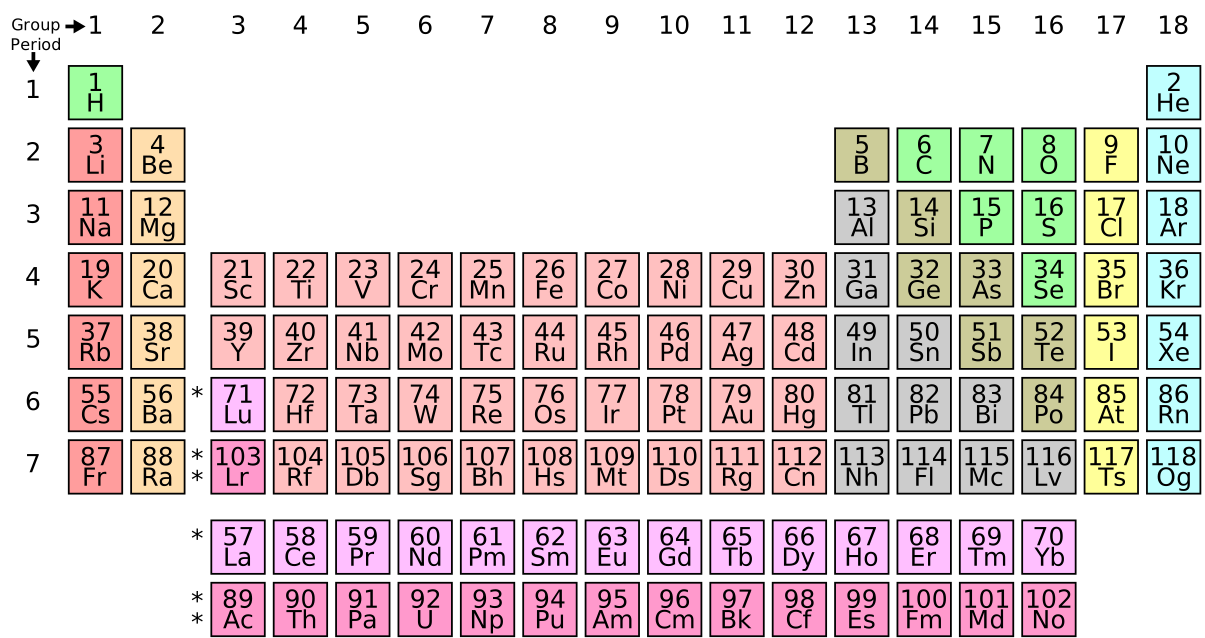
Structure of the periodic table

  • Elements arranged in order of atomic number (proton number)
  • Period = horizontal row. Period number = number of electron shells.
  • Group = vertical column. Group number = number of outer electrons (for groups 1–7).
  • Elements in the same group have the same number of outer electrons → similar chemical properties.
  • Metals on the left and centre. Non-metals on the right. Metalloids on the diagonal boundary.

Group 1 — alkali metals (Li, Na, K, Rb, Cs, Fr)

  • All have 1 outer electron → very reactive, form +1 ions.
  • Reactivity increases down the group (outer electron further from nucleus, easier to lose).
  • React with water → metal hydroxide + hydrogen. E.g. 2Na + 2H₂O → 2NaOH + H₂
  • Low density (Li, Na, K float on water). Soft metals — cut with a knife.
  • Stored in oil to prevent reaction with water/oxygen in air.

Group 7 — halogens (F, Cl, Br, I, At)

  • All have 7 outer electrons → form –1 ions, gain 1 electron.
  • Reactivity decreases down the group (harder to gain electron further from nucleus).
  • More reactive halogen displaces less reactive: Cl₂ + 2KBr → 2KCl + Br₂
  • F₂ = pale yellow gas. Cl₂ = yellow-green gas. Br₂ = orange-brown liquid. I₂ = grey solid.
  • Used as disinfectants (Cl₂ in water treatment).

Transition metals

  • Found in central block (periods 4–7).
  • High melting points, high density, good conductors.
  • Can form ions with different charges (e.g. Fe²⁺ and Fe³⁺).
  • Often form coloured compounds.
  • Good catalysts (e.g. iron in Haber process, nickel in hydrogenation).
  • Less reactive than Group 1 metals.
Exam questions — 4 questions · 11 marks
This module includes extended questions. Read the hint. Write in full sentences. The AI marks against the real AQA mark scheme.
1 markGroup trendsAQA 8462 style

Which statement correctly describes the reactivity of Group 1 metals?

A Reactivity decreases down the group as atomic radius increases
B Reactivity increases down the group as the outer electron is further from the nucleus and more easily lost
C Reactivity stays the same because all Group 1 metals have 1 outer electron
D Reactivity decreases down the group as density increases
1 markHalogen displacementAQA 8462 style

Chlorine water is added to potassium iodide solution. What would you observe?

A No reaction — chlorine is less reactive than iodine
B The solution turns brown as iodine is displaced by chlorine
C A white precipitate forms
D Hydrogen gas is produced
4 marksGroup 1 reactionsAQA 8462 P1 style

Potassium is added to water. Write the word equation and symbol equation for this reaction, and explain why potassium reacts more vigorously than lithium. (4 marks)

Hint: Write both equations then explain using electron configuration and nuclear attraction.
+40 XP
4 marksTransition metals vs Group 1AQA 8462 P1 style

Give three ways in which transition metals differ from Group 1 metals in their properties. (3 marks)

Hint: Pick three clear contrasts. Use the word "than" to compare directly.
+40 XP

Module complete! 🎉

Score loading...

+10 XP