📈
Interactive tool -- label the graph
The real exam question is a bare reaction profile diagram -- practice labelling it from scratch
→
Watch first
Key facts & methods
Exothermic reactions — fill in the table
| Property | Detail |
|---|---|
| Energy transfer | |
| Products vs reactants | |
| Examples | |
| Reaction profile | |
| Temperature |
Endothermic reactions — fill in the table
| Property | Detail |
|---|---|
| Energy transfer | |
| Products vs reactants | |
| Examples | |
| Reaction profile | |
| Temperature |
Reaction profiles and activation energy — fill in the table
| Term | Definition |
|---|---|
| Reaction profile | |
| Activation energy (Eₐ) | |
| Exothermic profile | |
| Endothermic profile | |
| Catalyst |
Bond breaking and forming
- Energy is always required to break bonds (endothermic).
- Energy is always released when bonds form (exothermic).
- If energy needed to break bonds > energy released forming bonds → endothermic reaction overall.
- If energy released forming bonds > energy needed to break bonds → exothermic reaction overall.
- Overall energy change = energy released (bond forming) − energy required (bond breaking).
Exam questions — 4 questions · 11 marks · AQA 8462 style
Which statement correctly describes an exothermic reaction?
Classify each of the following as exothermic or endothermic, and give a reason: (a) combustion of methane (b) thermal decomposition of calcium carbonate (c) neutralisation of sodium hydroxide with hydrochloric acid. (3 marks)
Hint: Clue: anything that burns = exothermic. Thermal decomposition requires heat input = endothermic. Neutralisation = always exothermic.
+30 XP
In a reaction profile diagram, the activation energy is shown as:
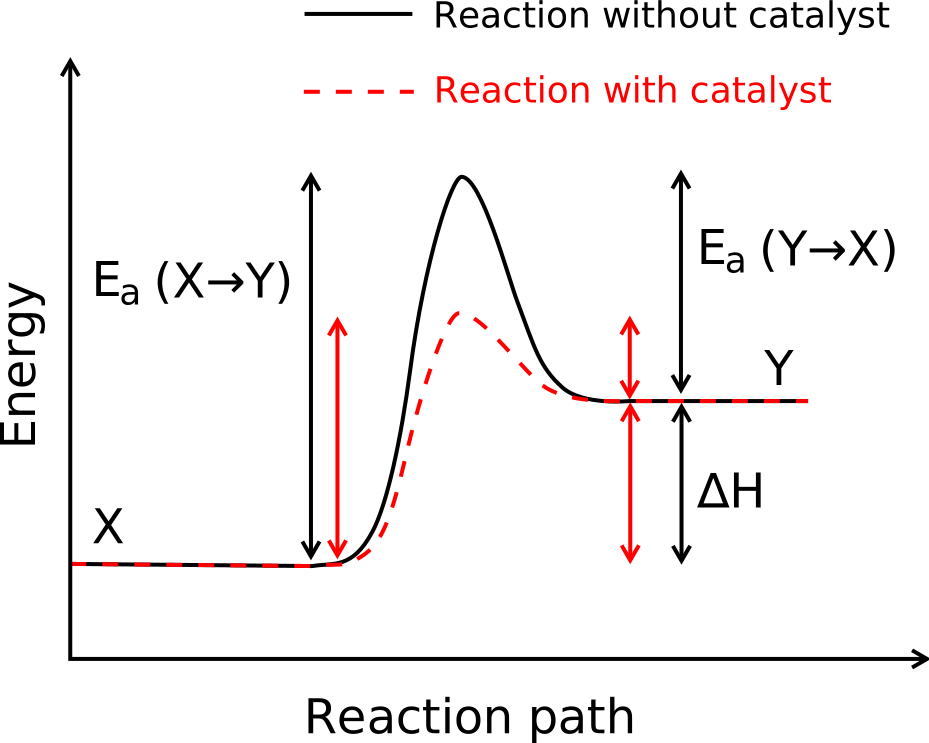
Sketch-describe a reaction profile for a catalysed and uncatalysed exothermic reaction on the same axes. Explain how the catalyst affects the activation energy and the overall energy change. (4 marks)
Hint: Both: same start and end energy (same overall ΔH). Difference: the peak is LOWER for the catalysed route. State explicitly that overall energy change is unchanged.
+40 XP
Quick recall flashcards