📈
Interactive tool -- label the graph
The real exam question is a bare reaction profile diagram -- practice labelling it from scratch
→
Watch first
MyGCSEScience · AQA Chemistry
Energy Changes — watch on MyGCSEScience
↗
Key facts
Exothermic vs endothermic — fill in the table
| Property | Exothermic | Endothermic |
|---|---|---|
| Energy | ||
| Temperature | ||
| ΔH sign | ||
| Examples | ||
| Bonds |
Bond energy calculations
- Energy required to break bonds in reactants → endothermic.
- Energy released when forming bonds in products → exothermic.
- Overall ΔH = energy in (breaking) – energy out (forming).
- If ΔH is negative → exothermic overall.
- If ΔH is positive → endothermic overall.
- Bond energies are given in kJ/mol for each type of bond (C–H, O=O, C=O, H–O, etc.).
Reaction profiles (energy diagrams) — fill in the table
| Term | Definition |
|---|---|
| Reaction profile | |
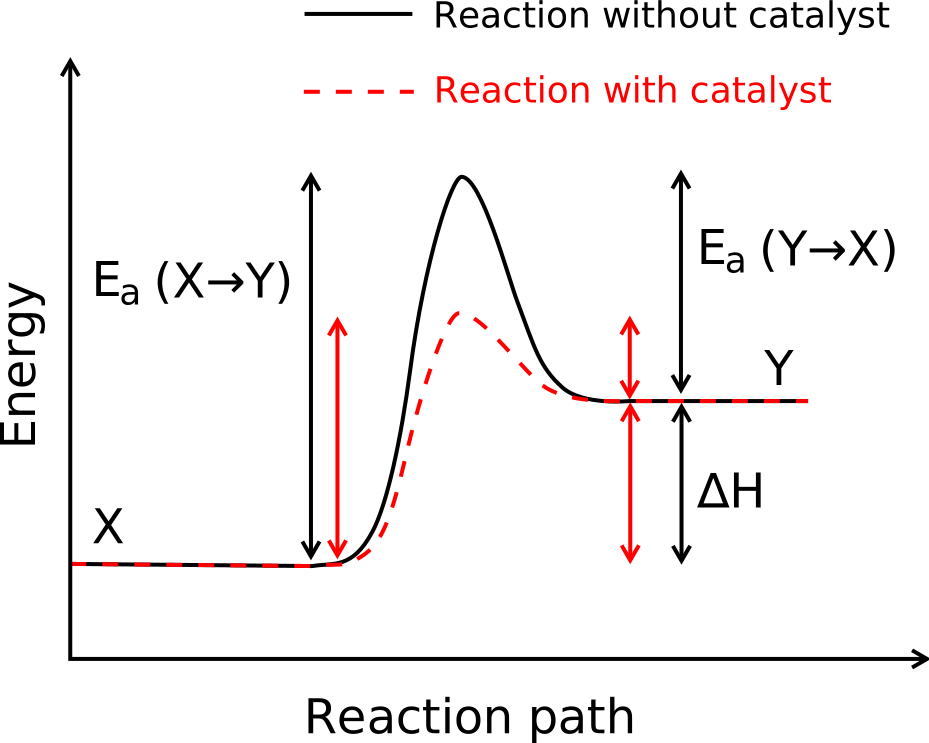
| Activation energy | |
| Exothermic profile | |
| Endothermic profile | |
| Catalyst |
Exam questions — 4 questions · 12 marks
In the reaction H₂ + Cl₂ → 2HCl, bond energies are: H–H = 436 kJ/mol, Cl–Cl = 243 kJ/mol, H–Cl = 432 kJ/mol. What is the overall energy change?
What effect does a catalyst have on a reaction?
Methane burns in oxygen: CH₄ + 2O₂ → CO₂ + 2H₂O Bond energies (kJ/mol): C–H = 413, O=O = 498, C=O = 805, O–H = 464 Calculate the overall energy change and state whether the reaction is exothermic or endothermic. Show all working. (4 marks)
Hint: Step 1: count and break all bonds in reactants. Step 2: count and form all bonds in products. Step 3: ΔH = energy in – energy out. Negative = exothermic.
+40 XP
Sketch and describe the reaction profile for an exothermic reaction. Label: reactants, products, activation energy, overall energy change (ΔH). (3 marks)
Hint: In an exothermic profile: reactants are at a higher energy level than products. The hump peak represents the transition state. Activation energy = height from reactants to peak.
+30 XP
Quick recall flashcards